Borderless connects students from international universities to collaborate digitally and address some of the global problems economists face today.
Students from UQ have competed with and against students from the University of Exeter in the South West of England.
Problem Statement
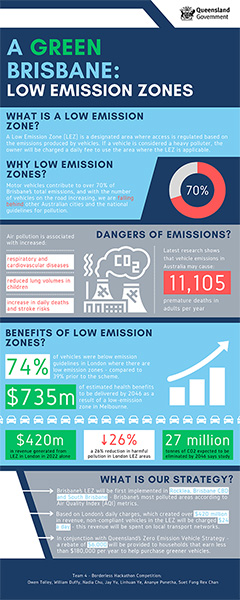
UK cities such as London and Glasgow have rolled out “low emissions zones” (LEZ) to reduce air pollution and encourage uptake of lower emissions or electric vehicles, among other benefits.
These policies also bring a variety of unintended consequences or side-effects, which may impact the overall benefit of the LEZ, or hold implications for how the LEZ should be designed/implemented.
Using the London LEZ as a case study, and as an economic advisor to the government minister for transport, you need to evaluate the merits of introducing a similar scheme in Brisbane to support the position adopted by the government (a position that your team is free to adopt and defend).
Task
Develop an infographic that supports the government’s policy position. Imagine you are developing the infographic for the Minister of Transport who needs to deliver a 5-minute pitch to the media to justify the government’s position. You need to ensure you:
- provide your team's brainstorming notes, diagrams, calculations, theoretical concepts etc to show your thinking processes
- condense your brainstorming notes into a narrative of approximately 300 words (in dot point format) that explains the key points that would inform the minister with sufficient information to address the media
- produce an infographic that the Minister can present and can be distributed to media outlets
- keep in mind the minister is not an economist. Hence your dot points should be based on economic theory but communicated using everyday language.
The results
 Winning team
- Jay Yu (Exeter)
- Nadia Chu (Exeter)
- Owen Tolley (Exeter)
- Suet Fung Rex Chan (Exeter)
- Ananye Punetha (Exeter)
- LinHuan Ye (UQ)
- William Duffy
The task
Part I: Lomeweb
Each student in each team was provided with an account on Lomeweb, a virtual economy. Once logged in, each participant produced, sold and consumed (i.e., bought various goods) on Lomeweb in accordance with the rules of this virtual economy. Members within each team were able to coordinate their choices on Lomeweb if desired (via various channels external to the platform).
During this phase, each team was tasked with maximising their accumulated resources – forming part of the team's total score.
Part II: Proposal
Each team was then to submit a response on the following challenge via video submission: Consider what you and your team have experienced from playing Lomeweb. Then by referring to economic theory, your own real-world personal experiences and observations, reflect on what Lomeweb has allowed you to learn. What you have learned about economic theory, as a team from playing Lomeweb, needs to be clearly and concisely captured in a video.
The results
Winning team
- Akshat Lal (Exeter)
- Joseph Christensen (UQ)
- Ikec Cleopatra Keinut (UQ)
- Nathan Peereboom (UQ)
Final scores were determined by the respective team's Lomeweb game play and video submissions.
The opinions expressed in this video reflect only the opinions of its authors. They do not represent the views of the organisers of the competition, nor those of The University of Exeter or The University of Queensland.
Borderless is an interuniversity competition run in partnership between the University of Exeter and The University of Queensland.